Organizations confront fragmented application deployment patterns where diverse software installations across workstations create security policy enforcement challenges, complicate vulnerability remediation workflows, and obscure the true scope of exposure requiring strategic intervention. Security Managers struggle to prioritize remediation efforts when confronted with thousands of potential application vulnerabilities across diverse technology stacks, while Security Analysts must balance the urgency of patching against operational stability requirements for business-critical applications supporting daily organizational functions. The Tenable Vulnerability Management report solves this issue by providing comprehensive application visibility across web browsers, productivity suites, collaboration platforms, and business-critical software enabling data-driven remediation prioritization based on actual deployment prevalence and business risk exposure rather than theoretical vulnerability severity scores alone.
Security Managers utilize application-centric risk prioritization methodologies to allocate remediation resources proportionally across exposure density tiers, enabling resource allocation decisions that match remediation capacity to application vulnerability concentrations within each deployment category. The report distinguishes between application visibility assessments revealing software deployment patterns and application exposure evaluations identifying active vulnerabilities requiring remediation coordination across installed software populations. Application deployment visibility chapters including Web Browser Visibility, Microsoft Application Installation Visibility, Oracle Application Visibility, and similar software deployment assessments enable Security Managers to quantify application deployment scope supporting standardization initiatives reducing operational complexity. Application exposure chapters including Top Web Browser Related Vulnerabilities, Top Microsoft Application Related Vulnerabilities, Top Adobe Application Exposures, and related vulnerability analyses enable Security Analysts to coordinate remediation campaigns addressing active vulnerabilities across deployed application populations requiring immediate intervention.
Security Analysts leverage asset-centric analysis approaches to identify hosts with concentrated application vulnerability exposure where remediation efforts will yield the greatest risk reduction across business-critical systems supporting operational continuity. The deployment-based prioritization methodology shifts focus toward applications exhibiting the widest organizational reach, ensuring remediation campaigns address exposures affecting maximum asset populations rather than pursuing narrow vulnerability-specific interventions creating fragmented remediation outcomes. Unsupported application assessments reveal installations operating beyond vendor support lifecycles where end-of-support status eliminates security update availability creating persistent exposure gaps requiring strategic migration investments rather than tactical remediation efforts. The analysis enables Security Managers to distinguish between applications requiring routine patching coordination and unsupported installations demanding migration planning, application replacement initiatives, or formal risk acceptance documentation justifying continued operation despite persistent exposure gaps lacking vendor-provided security updates.
The report unifies visibility across the modern application attack surface, bringing enterprise views of application deployment patterns and vulnerability exposure together as one comprehensive assessment exposing gaps that leave the Organization vulnerable to application-based attacks across diverse software installations and deployment patterns. The analysis unifies insight by connecting application deployment visibility with vulnerability exposure intelligence, identifying true application security gaps threatening organizational operations and regulatory compliance requirements governing data protection. The assessment unifies action by enabling Security Managers and Security Analysts to coordinate as one operational team, mobilizing organizational resources to address application vulnerabilities with the highest likelihood of exploitation and business impact supporting data-driven remediation prioritization decisions based on actual deployment prevalence and operational criticality rather than theoretical vulnerability severity classifications alone.
Chapters
Top Installed Applications: Security Analysts leverage application enumeration capabilities tracking software installations across the infrastructure where comprehensive application visibility depends on authenticated scanning delivering detailed application inventory data. Security Analysts reference application distribution data when evaluating software inventory management effectiveness and identifying application sprawl patterns requiring standardization interventions. The chapter supports software asset management initiatives by quantifying application deployment distributions and revealing unauthorized installation patterns requiring investigation or removal coordination.
Top Unsupported Applications Vulnerabilities: Security Managers employ this assessment to pinpoint applications operating beyond vendor support lifecycles where end-of-support status eliminates security update availability creating persistent exposure gaps requiring strategic migration investments. Detection logic combines application identification patterns with keywords indicating end-of-support status to surface at-risk software lacking ongoing vendor patch publication. The assessment ranks the two hundred most prevalent unsupported applications by deployment count revealing widespread installations requiring migration planning rather than tactical remediation efforts.
Installed Endpoint Management Application Visibility: Security Managers track endpoint management and monitoring agent deployments through this specialized inventory revealing protective control coverage gaps where expected security tooling has not achieved deployment targets across asset populations. The chapter catalogs security applications including antivirus solutions, backup agents, remote management platforms, configuration management tools, and endpoint detection capabilities detected within the most recent thirty-day period.
Top Endpoint Management Application Vulnerabilities: Security Managers prioritize vulnerabilities affecting endpoint management and security tooling where exposures compromise protective controls maintaining security posture and operational visibility across distributed infrastructure assets. The assessment ranks the two hundred most prevalent vulnerabilities by deployment count affecting critical monitoring agents, backup solutions, and endpoint detection systems requiring elevated remediation priority.
Microsoft Application Installation Visibility: Security Analysts gain targeted visibility into productivity application deployments where version sprawl creates patching complexity and licensing compliance concerns across the enterprise infrastructure. The inventory focuses on applications from a major productivity software vendor detected within the past thirty days that have not reached remediation or acceptance status.
Top Microsoft Application Related Vulnerabilities: Security Analysts review prevalent security exposures associated with major productivity applications where widespread vulnerabilities create significant organizational impact across business-critical software enabling daily operational functions. Vulnerability rankings reflect both severity levels and deployment count to highlight findings with the greatest organizational reach across employee populations utilizing productivity applications. The assessment focuses remediation efforts on the two hundred most widespread vulnerabilities affecting business-critical software requiring coordinated patching activities.
Web Browser Visibility: Security Managers utilize this chapter to quantify web browser deployment patterns across the Organization where fragmented browser installations create security baseline enforcement challenges and complicate vulnerability remediation efforts. The browser inventory reveals whether the Organization maintains disciplined browser standardization or whether employees have installed competing applications that fragment security control deployment. Browser applications represent primary vectors for web-based threats and phishing attacks, making deployment visibility essential for risk assessment and policy enforcement decisions.
Top Web Browser Related Vulnerabilities: Security Managers focus on prevalent vulnerabilities affecting web browsing applications where browser exposures serve as initial access vectors in phishing campaigns and watering hole attacks targeting employee workstations accessing internet resources. The assessment ranks the two hundred most widespread browser vulnerabilities by deployment count to highlight findings with maximum organizational reach across employee populations utilizing browsing applications. Browser vulnerabilities enable adversary initial access through compromised websites and malicious web content targeting employees performing routine internet access activities.
Java Installation Details: Comprehensive configuration visibility supports both vulnerability validation and compliance verification activities. This chapter documents software installations identified through scanning operations, focusing on informational severity findings that indicate software presence. Risk Managers reference installation details when evaluating whether deployed software versions align with organizational standards and licensing agreements. Security Operations Teams utilize installation documentation to validate vulnerability scan accuracy and investigate false positive reports.
Top Java Exposures by Tenable VPR: Traditional severity scoring systems quantify potential impact if vulnerabilities experience successful exploitation but provide limited guidance about exploitation likelihood. The Top Java Exposures by Tenable VPR chapter applies Vulnerability Priority Rating (VPR) scores that incorporate threat intelligence, exploit availability, and attack pattern data. Risk Managers utilize VPR scores to differentiate between vulnerabilities that threat actors actively target and those that remain theoretical despite high CVSS ratings. Security Operations Teams sequence remediation activities by addressing high-VPR exposures first, focusing on vulnerabilities where exploitation probability and impact severity both reach concerning levels.
Collaboration Application Visibility: Security Analysts track communication and conferencing application deployments where multiple competing platforms create security policy enforcement challenges and data governance concerns across the distributed workforce. The inventory catalogs collaboration platforms from various vendors detected across the infrastructure during the most recent thirty-day scanning window excluding remediated and accepted findings. Filtering logic captures installations of conferencing applications, instant messaging platforms, and team collaboration tools requiring security assessment.
Top Collaboration Application Exposures: Security Analysts evaluate vulnerabilities affecting communication and conferencing platforms processing sensitive business discussions and confidential file exchanges where collaboration tool exposures create regulatory compliance concerns and data exposure risks. The ranked assessment presents the two hundred most widespread collaboration tool vulnerabilities sorted by deployment prevalence revealing exposure patterns across communication platforms. Collaboration platforms represent attractive targets for adversaries seeking access to internal communications and shared documents containing sensitive business information.
Office Application Visibility: Security Analysts monitor productivity suite application deployments across the Organization where office applications enable document creation and data analysis supporting core business functions including financial reporting and contract management activities. The inventory captures spreadsheet tools, word processing applications, presentation software, and related components from multiple suite vendors detected within the most recent thirty-day period excluding remediated and accepted findings.
Top Office Application Exposures: Security Analysts focus remediation efforts on widespread vulnerabilities affecting office productivity suites where malicious document attacks leverage application exposures to deliver malware through email attachments and web downloads targeting employee workstations. The assessment ranks the two hundred most prevalent office suite vulnerabilities by deployment count to identify exposures with maximum organizational reach across employee populations. Office application vulnerabilities enable adversaries to deliver malware through malicious spreadsheets, weaponized documents, and embedded macros representing primary attack vectors requiring coordinated patching efforts.
Adobe Application Visibility: Security Analysts monitor document viewing and multimedia application deployments from a major creative software vendor where installations on standard business endpoints create potential security exposure given historical exploitation patterns targeting document processing applications. The inventory captures document readers, multimedia players, and creative suite components detected across the infrastructure during the most recent thirty-day scanning window excluding remediated and accepted findings.
Top Adobe Application Exposures: Security Managers evaluate vulnerabilities affecting document viewing and multimedia applications enabling daily business document exchange where exposures historically enable targeted attacks through malicious documents delivered via email attachments and web downloads. The ranked assessment presents the two hundred most widespread vulnerabilities sorted by deployment prevalence across the Organization revealing exposure patterns requiring coordinated remediation efforts. Document reader vulnerabilities represent significant organizational risk given widespread employee usage processing untrusted content from external sources during routine business operations.
VPN Client Visibility: Security Analysts track remote access client deployments where multiple competing applications create security baseline enforcement challenges and complicate remote workforce access control standardization across distributed employees. The inventory catalogs remote access client applications from various vendors deployed across the infrastructure during the most recent thirty-day scanning window excluding remediated and accepted findings.
Top VPN Client Exposures: Security Managers focus on vulnerabilities affecting remote access clients providing primary secure connectivity pathways for remote workers where client exposures represent critical security concerns enabling adversary network infiltration through compromised remote workforce connections. The assessment ranks the two hundred most prevalent remote access client vulnerabilities by deployment count to highlight exposures with broadest organizational reach across distributed employee populations. Remote access client vulnerabilities enable adversaries to leverage compromised applications for authenticated network access to corporate resources representing elevated organizational risk.
Oracle Application Visibility: Security Managers utilize this chapter to understand enterprise software deployment patterns where database clients, middleware components, and application server elements create complex remediation dependencies requiring coordination across multiple operational teams. The inventory identifies installations from a major enterprise software vendor detected across the infrastructure during the most recent thirty-day period excluding remediated and accepted findings. The ranked listing of the two hundred most prevalent enterprise software components reveals the Organization's technology footprint supporting mission-critical business applications and data management functions.
Top Oracle Application Exposures: Security Managers evaluate vulnerabilities affecting enterprise software components that underpin critical business applications and data management systems where patching complexity creates operational risk requiring careful coordination across production environments. The assessment ranks the two hundred most prevalent enterprise software vulnerabilities by deployment count to identify exposures with maximum organizational impact on business-critical systems. Enterprise software vulnerabilities expose sensitive business data and disrupt essential application functionality, demanding prioritization balancing security urgency against operational stability requirements.
Database Application and Elements Visibility: Security Managers track data management platform deployments across the infrastructure where database applications store sensitive customer information, financial records, and intellectual property requiring stringent security controls and access management. The inventory catalogs database technologies and related elements detected through pattern matching and plugin family classifications revealing the Organization's data storage architecture supporting business-critical operations.
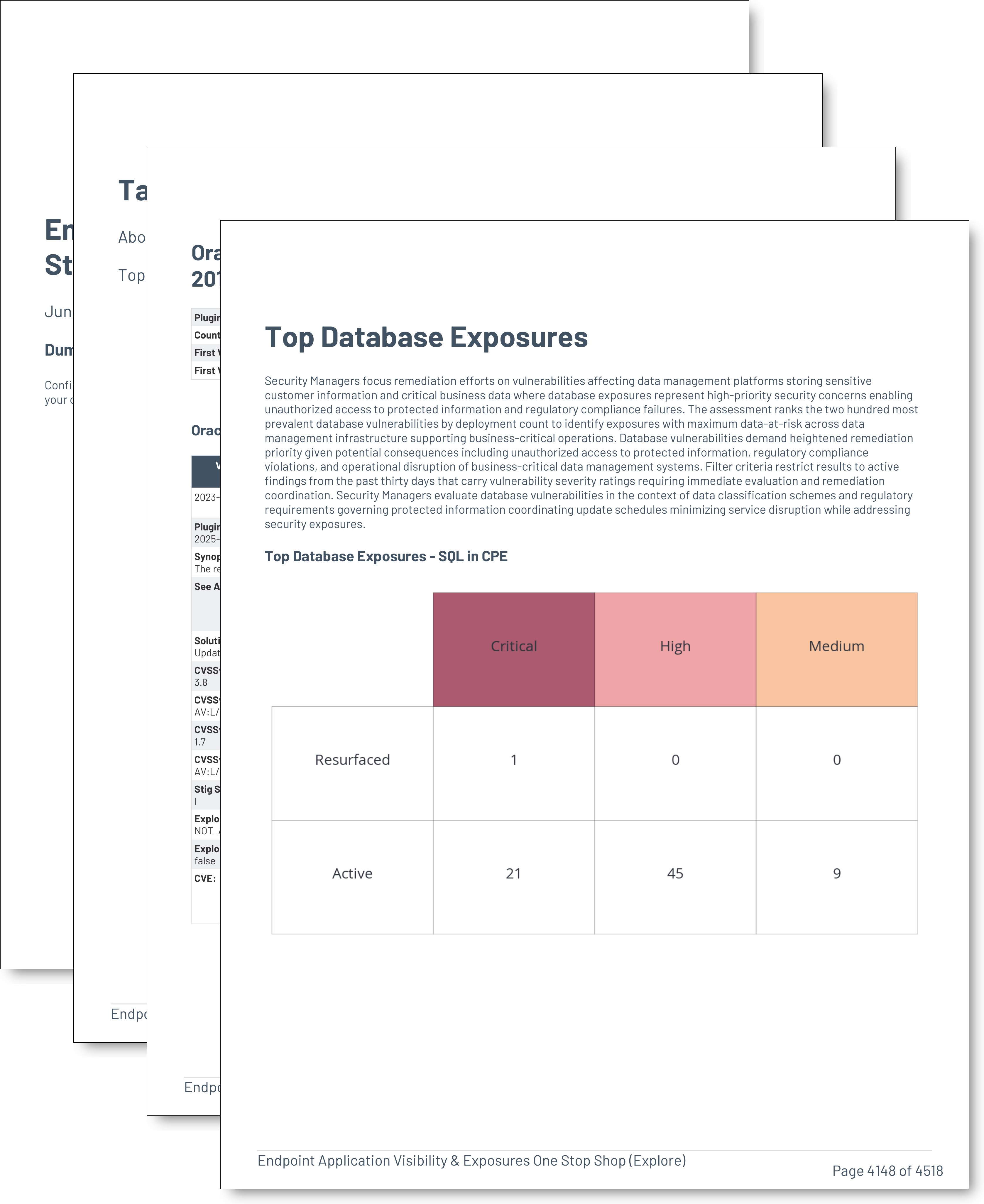
Top Database Exposures: Security Managers focus remediation efforts on vulnerabilities affecting data management platforms storing sensitive customer information and critical business data where database exposures represent high-priority security concerns enabling unauthorized access to protected information and regulatory compliance failures. The assessment ranks the two hundred most prevalent database vulnerabilities by deployment count to identify exposures with maximum data-at-risk across data management infrastructure supporting business-critical operations. Database vulnerabilities demand heightened remediation priority given potential consequences including unauthorized access to protected information, regulatory compliance violations, and operational disruption of business-critical data management systems.
Apache Application Visibility: Security Managers monitor open-source software component deployments where community-supported applications create security monitoring responsibilities requiring internal expertise to track security advisories and coordinate update management across development teams. The inventory captures applications from a major open-source software foundation detected across the infrastructure during the most recent thirty-day scanning window excluding remediated and accepted findings. The Organization benefits from open-source software cost savings while accepting responsibility for security monitoring and update coordination lacking vendor-driven patch publication cycles.
Top Apache Application Exposures: Security Analysts focus on vulnerabilities affecting open-source software components where the Organization bears direct responsibility for security monitoring and update coordination requiring independent expertise tracking community-published security advisories. The assessment ranks the two hundred most prevalent open-source software vulnerabilities by deployment count to highlight widespread exposures lacking commercial vendor patch publication cycles. Open-source components require active security monitoring as updates depend on community contributions rather than vendor-driven support cycles providing scheduled patch releases.
Tenable One
Request a demo
The world’s leading AI-powered exposure management platform.
Thank You
Thank you for your interest in Tenable One.
A representative will be in touch soon.
Form ID: 7469
Form Name: one-eval
Form Class: c-form form-panel__global-form c-form--mkto js-mkto-no-css js-form-hanging-label c-form--hide-comments
Form Wrapper ID: one-eval-form-wrapper
Confirmation Class: one-eval-confirmform-modal
Simulate Success